
Sleep Techniques
Sleep Sounds for Adults: Which Sounds Help You Fall Asleep
White, pink, and brown noise compared, what the research honestly says, and a simple way to match the sound to your night — plus how to use sleep sounds safely.
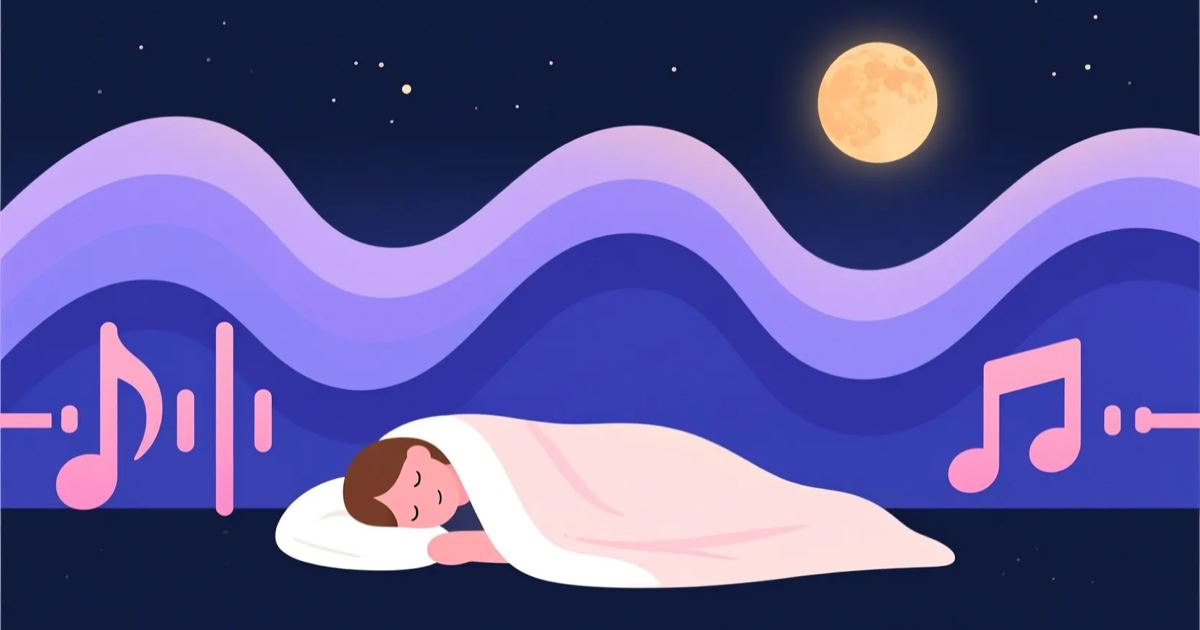
Steady, calming sound can make it easier to fall asleep — mostly by covering the noises that pull you back awake. There is no single "best" sleep sound for everyone: the right choice depends on what's actually keeping you up tonight, whether that's a busy street, a snoring partner, or a mind that won't quiet down.
Below you'll find the main types of sleep sounds, what the research honestly says about them, and a simple way to match a sound to your night. And if you're reading this because you're awake right now, our guide to what to listen to when you can't fall asleep starts with the rule that matters before you press play. Torn between plain sound and a spoken session? The head-to-head on guided sleep meditation vs sleep sounds sorts out which one fits your night.
🎧 Why Sound Can Help at Night
Sleep is fragile in a specific way: sudden changes in noise — a door, a siren, a bark — can bump you toward wakefulness even if you don't fully wake up and don't remember it in the morning. That's why a quiet-but-not-silent bedroom can be worse for sleep than a consistently noisy one. Unpredictable sounds are the problem; steady sound is not.
The most common explanation for why sleep sounds help is masking: a constant, even soundscape raises the baseline so that sudden noises stand out less. Instead of silence punctuated by disruptions, you get one continuous, predictable background. Researchers don't fully agree on everything sound does for sleep, but masking is the mechanism most often cited — see the Sleep Foundation's overview of white noise and masking.
There's a second, quieter benefit: sound gives an active mind something to rest on. If your thoughts usually spiral at bedtime, a steady rain sound can occupy just enough attention to interrupt the loop.
🔬 What the Research Actually Says
Honest version first: the evidence is promising but not settled.
- It may help you fall asleep faster. In one small randomized trial, healthy adults placed in a transient-insomnia model fell asleep measurably faster with steady broadband sound playing — the median time to fall asleep dropped about 38% (Messineo et al., 2017). Participants who said they usually had trouble falling asleep at home also reported better subjective sleep quality. Keep perspective, though: this was a small, early study designed to simulate insomnia, not proof for real-world insomnia.
- The overall evidence base is weak. A 2021 systematic review of 38 studies concluded that the quality of evidence for continuous noise improving sleep was very low — so low it "contradicts its widespread use" — and noted that in some cases noise has actually disturbed sleep or affected hearing (Riedy et al., Sleep Medicine Reviews).
- Natural sounds may be easier to relax to. An fMRI study found that listening to naturalistic sounds (rain, wind, water) was associated with outward-directed attention and parasympathetic — "rest and digest" — activity, while artificial sounds nudged listeners toward inward focus, the mode linked with rumination (Gould van Praag et al., 2017).
The practical takeaway: sleep sounds are a low-risk wind-down aid worth trying, not a treatment. If you regularly struggle to fall or stay asleep, that's a conversation to have with a doctor.
🎨 White, Pink, Brown, and Beyond
Sleep sounds come in a few families. The "colors" differ by how their energy is spread across frequencies:
- White noise — equal energy across all audible frequencies; often compared to static or a whirring fan. It's the strongest masker of the three, which is why it's the default for blocking environmental noise.
- Pink noise — energy decreases about 3 dB per octave, so lower frequencies are more prominent. Most people describe it as softer and more even: steady rainfall, or a waterfall heard from across the room. Many adults who find white noise harsh prefer pink.
- Brown noise — even deeper, dropping about 6 dB per octave. Think low rumble: a shower at full flow, distant surf. Popular for masking traffic and other bass-heavy noise.
- Nature sounds — rain on a window, ocean waves, a crackling fire. Less uniform than noise "colors," and that may be their advantage: natural soundscapes have been linked to greater relaxation and parasympathetic activity than artificial ones. Very steady recordings (constant rain) mask better than dynamic ones (birds that chirp unpredictably).
- Music and guided audio — slow, quiet, familiar instrumental music works for some listeners; spoken guided sessions work by giving attention somewhere to go. If your main problem is a racing mind rather than a noisy room, this family deserves a try.
Which sleep sound works best for adults comes down to two things: what noise you're masking, and what your mind does when the lights go off.
🌙 Matching the Sound to Your Night
Most articles give you a menu. Here's the decision instead — start from what's actually keeping you awake:
- A noisy street, thin walls, loud neighbors → Brown or white noise, played a touch louder. You need raw masking power for low, irregular sounds.
- A snoring partner → White noise in the ear closer to your partner, or a pink-noise bedside speaker. Consistency matters more than volume here; it smooths out the intermittent snores.
- A quiet room, but a loud mind → Masking won't help, because silence isn't the problem. Try nature sounds with gentle variation, or better, guided audio — something spoken that walks your attention down a path (a body scan, a breathing guide). If that's your pattern, our guide to guided sleep techniques covers these methods in detail.
- Travel and hotel nights → Bring a familiar sound. Part of what disturbs sleep in new places is acoustic unpredictability; a steady sound you associate with home partly restores the predictability.
- You can't say why you're awake → Start with pink noise. It's the least intrusive of the noise colors, and if it changes nothing after a few nights, your issue probably isn't sound.
One concrete example of a full setup: a rain-loop track at conversation volume, started 20 minutes before lights-out, while you do a few slow breathing cycles — for instance, the 4-7-8 pattern. The sound handles the room; the breathing handles you.
✅ How to Use Sleep Sounds Safely
Sleep sounds are low-risk, but a few habits keep them that way:
- Keep the volume modest — about the level of a background conversation. There's no official guideline, but regular exposure above 70 dB can harm hearing over time, per the CDC. If you can't hear a normal voice over your sleep sound, it's too loud.
- Place the speaker across the room, not next to your head — for speakers at least. If you use earbuds or headband speakers, keep the volume lower still.
- Use a timer or a track that fades. Sound matters most around sleep onset; playing all night isn't necessary, though some people prefer it for all-night masking.
- Give it a few nights. Any new sound can feel strange at first. Judge it after roughly a week, not one night.
- Skip sounds that grab attention. Anything with sudden changes — birdsong, variable music, podcasts — works against you, however pleasant it sounds at 9 p.m.
Somvia's Sleep Sounds are built around this use case: steady, low-arousal soundscapes designed to fade into the background, so you can pair the sound with a guided wind-down instead of managing a playlist. You can read how Somvia works to see where sounds fit in the full nightly routine.
❓ FAQ
Is it OK to sleep with sounds on every night?
White noise or pink noise for sleep — which is better?
Can sleep sounds cure my insomnia?
How loud should sleep sounds be?
Your Nightly Soundtrack
Sound won't do the falling asleep for you. What it can do is make the room predictable, give a busy mind a place to rest, and turn bedtime from a struggle into a ritual: choose tonight's sound, set the volume low, breathe slowly, and let the audio fade as you drift.
Keep Reading
Somvia
Sleep, Guided by Sound
Guided sleep sessions that set the pace for your wind-down and fade as you drift — with steady Sleep Sounds to keep the room quiet underneath.
Learn moreThis article is for general information and is not medical advice. If you regularly struggle to fall or stay asleep, consult a healthcare professional.