
Sleep Techniques
What to Listen to When You Can't Fall Asleep
Guided audio, calm music, or steady sound — how to pick for tonight, what to skip, and the 20-minute rule that tells you when to get out of bed instead of pressing play.
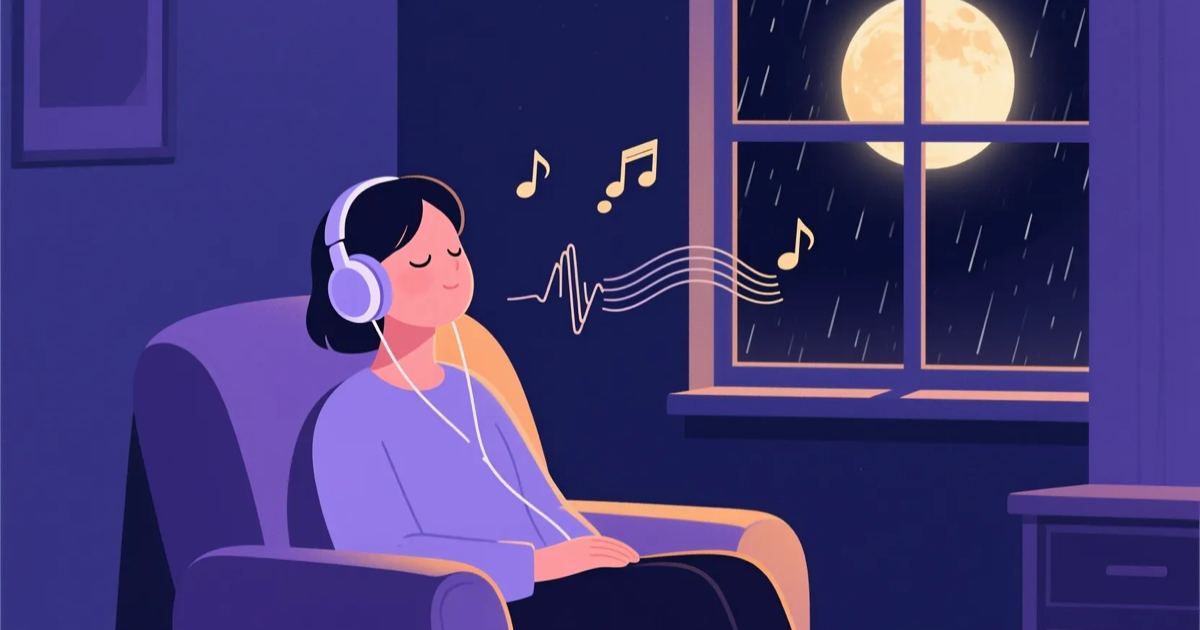
The honest answer to "what should I listen to when I can't fall asleep?" depends on why you're awake. If your mind is racing, put on something spoken — a guided sleep session or slow, familiar audio that gives your attention somewhere to go. If the room is noisy, steady sound works better than words. And if you've been lying awake for what feels like 20 minutes or more, the first move isn't audio at all: sleep specialists recommend getting out of bed and listening somewhere else, in low light, until you feel sleepy again.
Below is how to pick for each situation, what the evidence actually says about music and sound, what to avoid putting on — and the one rule worth knowing before you press play.
🛏️ The 20-Minute Rule Comes First
If you're choosing something to listen to because you've been lying awake a while, start here: staying in bed, awake and frustrated, is the habit worth breaking — not just tonight, but as a pattern.
Stimulus control, a standard behavioral approach for insomnia, works by reversing the learned association between your bed and being awake. In practice, its instructions run like this: when you estimate you've been unable to sleep for roughly 15–30 minutes, get up and go to another room, do something quiet and pleasant in low light, and return to bed only when you feel sleepy. If sleep still doesn't come, get up again — the original instructions say to repeat this as often as necessary through the night.
Three details from that protocol matter for what you're about to press play on:
- Estimate, don't watch the clock. The original instruction was deliberately vague about the time limit to avoid clock-watching, which turns "am I asleep yet?" into a timed test you can fail.
- Pick something pleasant, not productive. The 2025 review of stimulus control suggests genuinely enjoyable quiet activities — and warns against turning the wake-up into laundry or email, because that gives your insomnia a function.
- Don't lie back down on the couch. Stay seated; the point is to rebuild the link between bed and sleep.
Audio fits into this as part of the calm activity — a low-light room, a comfortable chair, and something easy to listen to. Keeping the lights low matters too: bright artificial light, the kind from TV and computer screens, can signal your brain that it's time to be awake, according to the NIH's National Heart, Lung, and Blood Institute (NHLBI).
Worth knowing: the need for this rule at all often gets decided hours earlier. Caffeine cutoffs, warm-shower timing, evening light, and a steady wake time shape how fast sleep arrives — how to fall asleep faster naturally walks the whole evening timeline.
🗣️ Spoken Word: Guides, Stories, and Podcasts
If the problem is a mind that won't stop — replaying the day, drafting tomorrow's emails — words often beat pure sound. A voice gives your attention a narrow path to follow, which leaves less room for the loop to restart. (For the full toolkit beyond audio — evening offloading, imagery, body scans — see how to relax your mind before bed.)
- Guided sleep audio is built for exactly this job: a calm voice sets a pace — slowing your breathing, walking your attention through your body — and then deliberately gets quieter as you drift. You don't have to count breaths or imagine a scene on your own; the audio carries the instructions. Our overview of guided sleep techniques covers the main types.
- Slow, familiar content — a book you've already read, a quiet narration of something uneventful — works for some listeners for the same reason: it's engaging enough to hold the mind, but too predictable to wake it up.
- Sleep stories and deliberately boring podcasts follow the same logic from the other direction: there's no plot to chase, so falling asleep mid-sentence costs you nothing.
One honest caveat: there's little formal research on podcasts or audiobooks as sleep aids specifically, so treat this as a practical tool to test for yourself rather than a proven method — same standard we'd hold for any wind-down trick.
🎵 Music: What the Evidence Actually Says
Music is the best-studied option on this list, and the findings are more encouraging than most one-line claims — but they come with real limits.
A 2022 Cochrane review pooled 10 randomized trials (708 participants) of listening to music with insomnia symptoms. Its conclusion: music may improve subjective sleep quality in adults with insomnia symptoms, with moderate-certainty evidence for that outcome (Jespersen et al., Cochrane 2022). For insomnia severity, the certainty was rated very low, and for falling asleep faster or sleeping longer, low. Also worth knowing: every trial compared music against no treatment or usual care — no one has tested music head-to-head against other approaches, so we can't say it's better than anything, only that it seems to help some people some amount.
If you're building a bedtime playlist, the studies suggest what tends to go into it:
- Low tempo — roughly 52 to 85 beats per minute in the reviewed trials, slower than most popular music
- Stable dynamics — no loud swells or sudden drops
- No strong rhythmic accents — even, flowing sound rather than prominent beats
In the studies, people listened for about 25 to 60 minutes at a time, so a playlist that outlasts your wind-down is about right. And the trials found no clear difference between researcher-chosen and listener-chosen music — familiar music you already love is a fair choice, as long as it's calm.
🌊 Steady Sound for a Noisy Room
If the problem is the room — traffic, thin walls, a snoring partner — you don't need words or melodies. You need a consistent soundscape that makes sudden noises stop standing out.
Two findings are worth knowing here. First, natural soundscapes (rain, wind, flowing water) have been linked in brain-imaging research to outward-directed attention and "rest and digest" activity, while artificial sounds nudged listeners toward inward focus — the mode associated with rumination (Gould van Praag et al., 2017). Second, in one small early trial of steady broadband sound, adults in a simulated-insomnia condition fell asleep about 38% faster on median — a promising result, but from a small study designed to model insomnia, not proof for everyday sleepers (Messineo et al., 2017).
Which sound family to pick — white, pink, brown noise, or nature — is its own decision, and we've covered it in detail in sleep sounds for adults, including how to match a sound to what's actually disturbing your night.
🚫 What Not to Listen To
The fastest way to waste a good night is to put on something that wants your attention back:
- Anything with a plot you're invested in. If the cliffhanger lives in the next episode, part of your brain stays up to find out.
- News, debate, and high-energy talk. Content that provokes a reaction — agreement, annoyance, adrenaline — is arousal, not wind-down.
- Comedy that makes you want to keep your eyes open. Laughing and listening "just one more bit" is the opposite of drifting off.
- Videos. Whatever's playing, a bright screen next to the bed adds the light problem on top of the content problem — the NIH notes that bright artificial light can signal the brain it's time to be awake.
- Anything loud. The volume that helps at 9 p.m. as gentle background can be too much pressed against your ear at midnight. Keep it around the level of a quiet conversation, and softer still if you're using anything worn in or over your ears.
🌙 A 2 a.m. Sequence You Can Repeat
Putting it all together, here's what a single mid-night wake-up can look like:
- You notice you've been awake a while. Don't check the time — estimate. If it feels like 20 minutes or more of no sleep, move to step 2.
- Get up, leave the bedroom, keep the light low. Sit somewhere comfortable — not lying down.
- Put on calm audio: a guided sleep session, slow familiar music, or the steady sound that matches whatever noise problem you have.
- Let it play while you're simply there — no tasks, no scrolling, no clock.
- Go back to bed when you feel sleepy, not when you think you should. If sleep doesn't come this time either, repeat from step 2.
- In the wind-down before bed — not at 2 a.m. — is also the right moment for slow breathing exercises like the 4-7-8 pattern, which pair naturally with whatever you're listening to.
One night of this usually isn't the point. If waking up at night is a regular pattern, the sequence is worth keeping in your routine — and if it's frequent and frustrating enough to affect your days, that's worth raising with a doctor. Behavioral approaches like the one above are pieces of standard insomnia care, but self-help audio is not a substitute for it.
❓ FAQ
Is it bad to fall asleep with something playing all night?
What's better when you can't sleep: music, podcasts, or white noise?
What if I still can't fall asleep even with something playing?
Does listening to something before bed really work?
Should I use headphones or a speaker?
Your 2 a.m. Playlist, Simplified
There's no single right thing to listen to when you can't sleep — there's the right thing for tonight: words if your mind is loud, steady sound if the room is, and getting out of bed if you've been awake too long for either to help. Everything you put on should ask less of you, not more.
Somvia's guided sleep sessions are built around this exact use case: a voice that sets the pace for your wind-down and fades as you drift, with steady Sleep Sounds to keep the room quiet underneath.
Keep Reading
Somvia
Sleep, Guided by Sound
Guided sleep sessions that set the pace for your wind-down and fade as you drift — with steady Sleep Sounds to keep the room quiet underneath.
Learn moreThis article is for general information and is not medical advice. If you regularly struggle to fall or stay asleep, consult a healthcare professional.